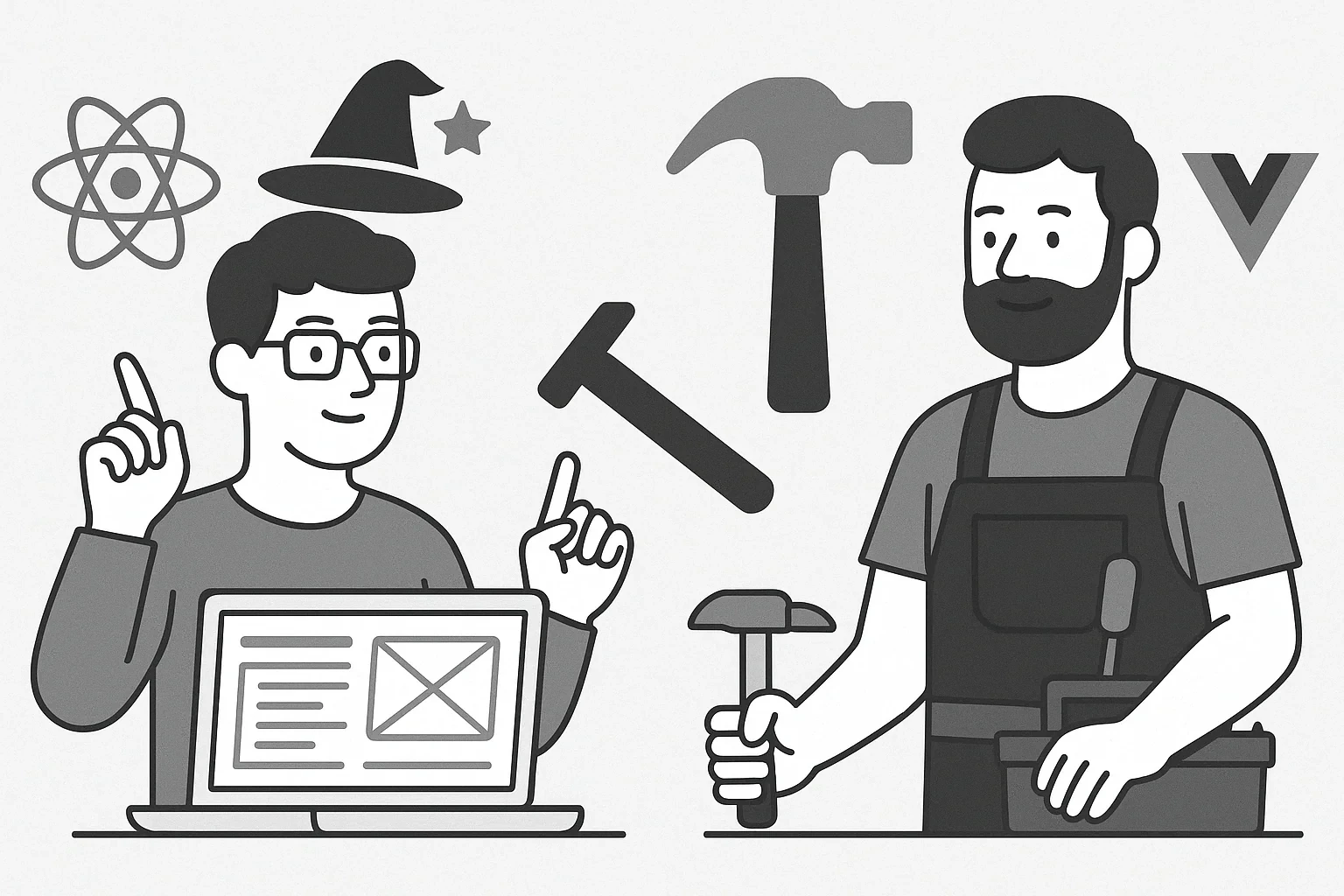
Why we obsess over tools and frameworks
Ever watch a master carpenter at work? They've got a tool belt overflowing with saws, hammers, levels, and gadgets. Each tool has a purpose, and while they might have a favorite brand, one thing is clear: they know how to build, regardless of whether their drill is a DeWalt or a Milwaukee.
Front-end developers work the same way. Our tool belts hold frameworks like React, Vue, Angular, and Svelte. JavaScript is our hammer, the core skill that drives everything. HTML is our lumber, the structure we build on. CSS, whether vanilla or utility-first like Tailwind, is how we add the finish.
A seasoned carpenter can pick up a new brand of saw and still make a perfect cut. A skilled front-end developer can do the same with an unfamiliar framework. React's component-based architecture is a different way to organize your "wood" compared to Vue's template system. Angular's opinionated structure is a detailed blueprint. Svelte's compiler-driven approach is another path to the same destination. The tools differ; the craft doesn't.
A component is a component. A loop is a loop. Managing state is about keeping track of your materials. Syntax and documentation style vary across frameworks, but the underlying logic stays the same. You either understand how to manipulate the DOM with JavaScript, or you don't. You either grasp CSS layout fundamentals, or you don't. Which framework you've used most is usually a matter of exposure and project requirements.
Here's where it gets frustrating. Imagine a construction company spending months searching for a carpenter who only uses Stanley hammers and refuses to touch a Craftsman. Absurd, right? Yet that's what happens in front-end hiring. Job postings are hyper-specific, demanding years of experience in one particular framework, sometimes down to minor version numbers. Interviewers grill candidates on the nuances of a single "brand" of tool, overlooking the HTML, CSS, and JavaScript fundamentals that actually make a developer effective.
This obsession with framework brands does a disservice to companies and developers alike. Companies miss out on talented people with strong core skills who could become productive in a new framework within days or weeks, not months. Developers, especially those early in their careers or with broad skill sets, get filtered out based on which brand they've used most recently.
Instead of searching for the "React with Redux and Tailwind CSS v3.x ninja," prioritize candidates who demonstrate a strong understanding of front-end fundamentals. Hire the carpenter who knows how to build a sturdy structure, regardless of their preferred nail gun brand. A skilled developer can read the documentation for a new framework and get up to speed fast.
Value the craft: the fundamental understanding of HTML, CSS, and JavaScript. That matters more than allegiance to a particular tool brand. A hammer is a hammer. A great front-end developer is a great front-end developer, no matter which framework logo is on their virtual tool belt.